Use One or Two Examples to Explain the Importance of Symbolism in Early Christian Art
Christian symbolism is the use of symbols, including archetypes, acts, artwork or events, by Christianity. It invests objects or actions with an inner meaning expressing Christian ideas.
The symbolism of the early on Church was characterized by being understood past initiates only,[1] while subsequently the legalization of Christianity in the Roman Empire during the 4th century more recognizable symbols entered in utilise. Christianity has borrowed from the common stock of significant symbols known to nearly periods and to all regions of the world.[ii]
Only a minority of Christian denominations have skilful Aniconism, or the abstention or prohibition of types of images. These include early Jewish Christians sects, as well equally some modern denominations such as Baptists[ which? ] that prefer to some extent non to employ figures in their symbols due to the Decalogue's prohibition of idolatry.
Early on Christian symbols [edit]
Cantankerous and crucifix ✝︎ 
 [edit]


The shape of the cross, every bit represented by the letter T, came to be used every bit a "seal" or symbol of Early Christianity by the second century.[iii] At the finish of the 2nd century, information technology is mentioned in the Octavius of Minucius Felix, rejecting the claim by detractors that Christians worship the cross.[4] The cross (crucifix, Greek stauros) in this period was represented by the letter T. Cloudless of Alexandria in the early tertiary century calls information technology τὸ κυριακὸν σημεῖον ("the Lord's sign") he repeats the idea, current as early on every bit the Epistle of Barnabas, that the number 318 (in Greek numerals, ΤΙΗ) in Genesis fourteen:14 was a foreshadowing (a "type") of the cross (T, an upright with crossbar, standing for 300) and of Jesus (ΙΗ, the offset two letters of his name ΙΗΣΟΥΣ, standing for 18).[five]
Clement's contemporary Tertullian also rejects the accusation that Christians are crucis religiosi (i.e. "adorers of the gibbet"), and returns the accusation by likening the worship of pagan idols to the worship of poles or stakes.[6] In his volume De Corona, written in 204, Tertullian tells how it was already a tradition for Christians to trace repeatedly on their foreheads the sign of the cantankerous.[vii]
While early Christians used the T-shape to represent the cantankerous in writing and gesture, the use of the Greek cantankerous and Latin cantankerous, i.e. crosses with intersecting beams, appears in Christian fine art towards the finish of Belatedly Antiquity. An early on example of the cruciform halo, used to identify Christ in paintings, is found in the Miracles of the Loaves and Fishes mosaic of Sant'Apollinare Nuovo, Ravenna (dated c. 504).

20th–21st century Celtic cross with inscribed symbolism
Instances of the St Thomas cross, a Greek cross with clover leaf edges, popular in southern India,[viii] date to nearly the 6th century.[ citation needed ]
The Patriarchal cross, a Latin cross with an additional horizontal bar, offset appears in the 10th century.
The Celtic cross, now often characterized by the presence of the outline of a circle upon which a cross, stylized in a pre-Medieval Celtic fashion, appears superimposed. The Celtic cantankerous bears strong resemblance to the Christian cross; however, the Celtic cross motif predates Christianity by at least three,000 years. Information technology appears in the class of heavily sculpted, vertically oriented, aboriginal monoliths which survive in the present 24-hour interval, in various locations on the island of Ireland. A few of the ancient monuments were evidently relocated to stand in some of Republic of ireland'southward earliest churchyards, probably between 400 CE and 600 CE, as Christianity was popularized throughout much of the isle. The heavily-worn rock sculptures probable owe their continued survival to their sheer size and solid stone structure, which coordinate in calibration, and in composition, with Ireland'south ancient megalith arrangements.
Unlike the Christian cross iconography associated with the shape of a crucifix (commonly used for torture and execution of criminals and captured enemy prisoners-of-war, by the pre-Christian Roman Empire), the Celtic cross' blueprint origins are not articulate. The Celtic cross has nevertheless been repeated in bronze, as a dominant characteristic of the anthropogenic Irish landscape, for at least 5,000 years. The Celtic cantankerous and the Christian cantankerous are similar enough in shape, that the former was easily adopted by Irish gaelic Catholic civilization, following the Christianization of Republic of ireland. The Celtic cantankerous is accurately described as an aboriginal symbol of cultural significance in pre-Christian, Druidic Republic of ireland. It also is used as a symbolic icon of the interpretation of Christianity, unique to Irish culture in that pre-Christian Celtic tradition and Irish Druidic iconography are hybridized with Christian traditions and iconography (much like the Shamrock; a low-growing, daintily foliaged, dense ground embrace plant, which is held every bit a timeless symbol of Ireland itself; and, which is too symbolic on Republic of ireland, of the Christian Holy Trinity, due to the Shamrock'southward typical trifoliar leafage structure).
Although the cross was used as a symbol by early on Christians, the crucifix, i.east. depictions of the crucifixion scene, were rare prior to the 5th century; some engraved gems thought to be second or third century have survived, but the subject does not appear in the fine art of the Catacombs of Rome.[9] The purported discovery of the True Cross by Constantine's mother, Helena, and the development of Golgotha as a site for pilgrimage led to a change of mental attitude. Information technology was probably in Palestine that the prototype developed, and many of the earliest depictions are on the Monza ampullae, small metal flasks for holy oil, that were pilgrim's souvenirs from the Holy Land, also as 5th century ivory reliefs from Italy.[10]
In the early medieval period, the plain cantankerous became depicted as the crux gemmata, covered with jewels, as many real early on medieval processional crosses in goldsmith work were. The first depictions of crucifixion displaying suffering are believed to take arisen in Byzantine art,[11] where the "S"-shaped slumped trunk type was developed. Early Western examples include the Gero Cross and the reverse of the Cross of Lothair, both from the stop of the 10th century.
Marie-Madeleine Davy (1977) described in great detail Romanesque Symbolism as information technology developed in the Eye Ages in Western Europe.[12]
Ichthys  [edit]
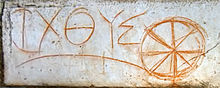
A written Ichthys from ancient Ephesus
Amongst the symbols employed past the early Christians, that of the fish seems to have ranked showtime in importance. Its popularity amongst Christians was due principally to the famous acrostic consisting of the initial letters of five Greek words forming the word for fish (Ichthus), which words briefly but clearly described the character of Christ and the claim to worship of believers: " Ἰησοῦς Χριστὸς Θεοῦ Υἱὸς Σωτήρ ", (Iēsous Christos Theou Huios Sōtēr), meaning, Jesus Christ, Son of God, Saviour.[13] This caption is given among others by Augustine in his Civitate Dei.[fourteen]
Alpha and Omega  [edit]

Jesus depicted with the alpha and omega letters in the catacombs of Rome from the quaternary century
The utilize since the earliest Christianity of the start and the final letters of the Greek alphabet, alpha (α or Α) and omega (ω or Ω), derives from the argument said by Jesus (or God) himself "I am Alpha and Omega, the First and the Last, the First and the End" (Revelation 22:13, also 1:viii and 21:vi).
Staurogram  [edit]

The Staurogram ⳨ (from the Greek σταυρός , i.e. cross), besides Monogrammatic Cross or Tau-Rho symbol, is composed past a tau (Τ) superimposed on a rho (Ρ). The Staurogram was first used to abbreviate the Greek word for cross in very early New Testament manuscripts such equally P66, P45 and P75, almost like a nomen sacrum, and may visually have represented Jesus on the cross.[15]
Ephrem the Syrian in the 4th-century explained these two united letters stating that the tau refers to the cross, and the rho refers to the Greek word "assistance" ( Βoήθια [sic]; proper spelling: Βoήθεια ) which has the numerological value in Greek of 100 as the letter rho has. In such a way the symbol expresses the idea that the Cross saves.[15] The ii letters tau and rho can also be constitute separately as symbols on early Christian ossuaries.[16]
The Monogrammatic Cross was later seen also equally a variation of the Chi Rho symbol, and information technology spread over Western Europe in the 5th and sixth centuries.[17]
Chi Rho  [edit]

The Chi Rho is formed by superimposing the first two (capital) letters chi and rho (ΧΡ) of the Greek word "ΧΡΙΣΤΟΣ" =Christ in such a way to produce the monogram. Widespread in ancient Christianity, it was the symbol used by the Roman emperor Constantine I equally vexillum (named Labarum).
IH monogram  [edit]
The first two letters of the name of Jesus in Greek, iota (Ι) and eta (Η), old superimposed 1 on the other, or the numeric value eighteen of ΙΗ in Greek, was a well known and very early mode to represent Christ.[18] This symbol was already explained in the Epistle of Barnabas and past Cloudless of Alexandria. For other christograms such equally IHS, see Article Christogram.
IX monogram  [edit]
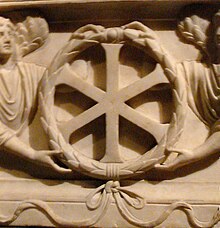
An early form of the monogram of Christ, found in early Christian ossuaries in Palaestina, was formed by superimposing the kickoff (majuscule) messages of the Greek words for Jesus and Christ, i.e. iota Ι and chi Χ, and then that this monogram ways "Jesus Christ".[sixteen] : 166 Another more complicated explanation of this monogram was given by Irenaeus[xix] and Pachomius: considering the numeric value of iota is 10 and the chi is the initial of the word "Christ" (Greek: ΧΡΕΙΣΤΟΣ [sic]; proper spelling: ΧΡΙΣΤΟΣ ) which has 8 letters, these early fathers calculate 888 ((10*viii)*10)+((10*8)+8) which was a number already known to represent Jesus, being the sum of the value of the letters of the proper name "Jesus" ( ΙΗΣΟΥΣ ) (10+8+200+70+400+200).[16] : 169–170
Other Christian symbols [edit]
The Skilful Shepherd [edit]

The image of the Good Shepherd, often with a sheep on his shoulders, is the most common of the symbolic representations of Christ found in the Catacombs of Rome, and it is related to the Parable of the Lost Sheep. Initially it was also understood as a symbol similar others used in Early Christian art. By about the 5th century the figure more often took on the appearance of the conventional depiction of Christ, equally it had developed by this time, and was given a halo and rich robes.
Dove [edit]

The dove as a Christian symbol is of very frequent occurrence in ancient ecclesiastical art.[20] Co-ordinate to Matthew 3:16, during the Baptism of Jesus the Holy Spirit descended like a dove and came to residue on Jesus. For this reason the pigeon became a symbol of the Holy Spirit and in general information technology occurs often in connection with early representations of baptism. It signifies also the Christian soul, non the human soul every bit such, but equally indwelt by the Holy Spirit; especially, therefore, as freed from the toils of the flesh and entered into residual and glory.[two] The Peristerium or Eucharistic pigeon was often used in the by, and sometime still used in Eastern Christianity, equally Church tabernacle.
Yet the more ancient explanation of the dove as a Christian symbol refers to it equally a symbol of Christ: Irenaeus[21] in the 2d century explains that the number 801 is both the numerological value of the sum in Greek of the letters of the discussion "dove" (Greek: περιστερά ) and the sum of the values of the letters Alpha and Omega, which refers to Christ. In the Bible story of Noah and the Flood, after the flood a dove returns to Noah bringing an olive branch as a sign that the water had receded, and this scene recalled to the Church Fathers Christ who brings salvation through the cross. This biblical scene led to interpreting the dove too equally a symbol of peace.
Peacock [edit]
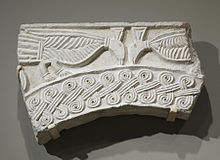
Two peacocks, symbolizing paradise and immortality, on a fragment from an eighth century ciborium from a church in Italia
Aboriginal Greeks believed that the flesh of peafowl did non disuse after death, and and then it became a symbol of immortality. This symbolism was adopted by early Christianity, and thus many early Christian paintings and mosaics prove the peacock. The peacock is still used in the Easter season especially in the east.[22] The "optics" in the peacock'southward tail feathers symbolise the all-seeing God and – in some interpretations – the Church. A peacock drinking from a vase is used as a symbol of a Christian believer drinking from the waters of eternal life. The peacock can too symbolise the creation if one interprets its tail with its many "eyes" as the vault of heaven dotted by the sun, moon, and stars. By adoption of quondam Persian and Babylonian symbolism, in which the peacock was associated with Paradise and the Tree of Life, the bird is again associated with immortality. In Christian iconography the peacock is often depicted next to the Tree of Life.
Pelican [edit]

In medieval Europe, the pelican was thought to be particularly circumspect to her immature, to the point of providing her own blood by wounding her own chest when no other food was available. As a event, the pelican became a symbol of the Passion of Jesus and of the Eucharist since well-nigh the 12th century.[23]
Anchor 
 [edit]
Christians adopted the anchor as a symbol of hope in future existence because the anchor was regarded in ancient times as a symbol of prophylactic. For Christians, Christ is the unfailing hope of all who believe in him: Saint Peter, Saint Paul, and several of the early Church Fathers speak in this sense. The Epistle to the Hebrews 6:19–20 for the start time connects the idea of hope with the symbol of the anchor.[24]
A fragment of inscription discovered in the catacomb of St. Domitilla contains the ballast, and dates from the end of the 1st century. During the 2nd and 3rd centuries the anchor occurs oft in the epitaphs of the catacombs. The most common grade of anchor institute in early on Christian images was that in which 1 extremity terminates in a ring adjoining the cantankerous-bar while the other ends in two curved branches or an arrowhead; There are, however, many deviations from this form.[24] In full general the anchor can symbolize promise, steadfastness, calm and sophistication.[25]
Shamrock  [edit]

St. Patrick with shamrock, from St. Benin's Church building, Wicklow, Ireland
Traditionally, the shamrock is said to have been used by Saint Patrick to illustrate the Christian doctrine of the Holy Trinity when Christianising Ireland in the fifth century.
A common myth is that St. Patrick used the shamrock – a small plant with chemical compound leaves, typically equanimous of three middle-shaped leaflets; and, a very familiar sight to the Irish – to illustrate the tripartite form of the Christian deity. Unlike many other tripartite mythologies, such as the native Irish Morrigan mythology, Christianity is a monotheistic religion. The common triple-leaflet, chemical compound-leaved shamrock- which exhibits just one compound-triplet leaf per stalk- could easily be used to illustrate the Father, the Son, and the Holy Ghost, described as being a single God; comparable to each of the three leaflets, which, together, form one shamrock. The Christianization, of the previously Celtic Druidic island culture, began in the quaternary century, CE. Christianization continued to dramatically influence, and change, Irish cultural practices and schools of idea, through the 6th century, CE
Middle of Providence [edit]

The Eye of Providence in Pontormo's Supper at Emmaus is thought to have been added in by some other artist.
In late Renaissance European iconography, the Eye of Providence, surrounded by a triangle, was an explicit image of the Christian Trinity.[26] Seventeenth-century depictions of the Eye sometimes show it surrounded by clouds or sunbursts.[27] The Eye of God in a triangle is still used in church architecture and Christian art to symbolize the Trinity and God's attendance and divine providence. The Centre of Providence is depicted on the backside of the U.S. $ane beak between the words, "Annuit cœptis", which translates as "Providence favors our undertakings" or "Providence has favored our undertakings".[28]
Elemental symbols [edit]
The early Church fabricated wide utilize of elemental symbols. H2o has specific symbolic significance for Christians. Exterior of baptism, water may stand for cleansing or purity. Fire, particularly in the form of a candle flame, represents both the Holy Spirit and light. These symbols derive from the Bible; for example from the tongues of fire [29] that symbolized the Holy Spirit at Pentecost, and from Jesus' description of his followers equally the light of the globe;[30] or God is a consuming fire plant in Hebrews 12.[31] Compare Jewish symbolism.
Lily crucifix [edit]
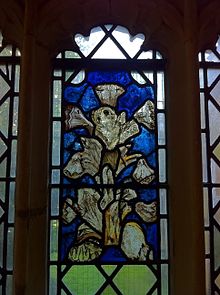
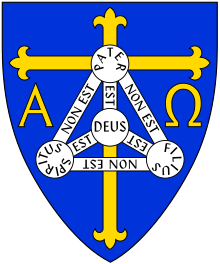
The glaze of arms of the Anglican diocese of Trinidad contains several Christian visual symbols
A lily crucifix is a rare symbol of Anglican churches in England. It depicts Christ crucified on a lily, or belongings such a constitute. The symbolism may exist from the medieval conventionalities that the Announcement of Christ and his crucifixion occurred on the same day of the year, March 25.[32] (The lily, in the context of the Annunciation, emphasises the purity of the Virgin Mary.)
In that location are few depictions of a lily crucifix in England. One of the nearly notable is a painting on a wall in a higher place the side altar at All Saint's Church building, Godshill, Isle of Wight. Other examples include: The rare depictions of a lily crucifix in England include most notably a painting on a wall above the side altar at All Saint'southward Church, Godshill, Island of Wight. Other examples include:
- An alabaster case on a tomb in St Mary'southward Church, Nottingham.
- an alabaster example on a tomb in St Mary'due south Church, Nottingham
- The Lady Chapel of St Helen's, Abingdon, Oxfordshire, has a wall painting.
- a wall paining in the Lady Chapel of St Helen's, Abingdon, Oxfordshire
- 5 examples are in glass as at Holy Trinity Church, Long Melford.
- v examples in glass as at Holy Trinity Church, Long Melford
- At All Saints, Bang-up Glemham, Suffolk, the image is on the base of operations of a font.
- an image on the base of operations of a font at All Saints, Great Glemham, Suffolk
- At St Mary, Binham, Norfolk, an image in a demote cease may be a lily crucifix.
- a possible lily crucifix in a bench cease at St Mary, Binham, Norfolk
- In Tong, Shropshire, St Bartholomew's Church choir stall No. 8 depicts a lily crucifix.
- choir stall No. 8 in St Bartholomew's Church building in Tong, Shropshire
- The Church of St John the Baptist, Wellington includes a lily crucifix in the etching of the centre mullion of the east window of the Lady chapel.[33]
Tomb paintings [edit]
Christians from the very kickoff adorned their catacombs with paintings of Christ, of the saints, of scenes from the Bible and allegorical groups. The catacombs are the cradle of all Christian fine art.[34] Early Christians accepted the art of their time and used it, also equally a poor and persecuted customs could, to express their religious ideas.[34] The use of deep, sometimes labyrinthine, catacombs for ritual burials are a production of the poverty of early Christian communities: the unusual, multileveled, burial chambers were, at surface-level, minor plots of land used as entrances to the tiered catacombs below, by early Christians unable to beget large areas of land, nor the respective taxes sometimes levied on real estate, by regional authorities.
From the 2nd half of the 1st century to the fourth dimension of Constantine the Corking they buried their dead and celebrated their rites in these underground chambers. The Christian tombs were ornamented with indifferent or symbolic designs—palms, peacocks, with the chi-rho monogram, with bas-reliefs of Christ as the Good Shepherd, or seated between figures of saints, and sometimes with elaborate scenes from the New Testament.[34]
Other Christian symbols include the dove (symbolic of the Holy Spirit), the sacrificial lamb (symbolic of Christ's sacrifice), the vine (symbolizing the necessary connectedness of the Christian with Christ) and many others. These all derive from the writings found in the New Attestation.[31] Other decorations that were common included garlands, ribands, stars landscapes, which had symbolic meanings, besides.[34]
Colours [edit]
Different colours are used in Christian churches to symbolise the liturgical seasons. They are ofttimes of clerical vestments, frontals and altar hangings. There is some variation between denominations, simply beneath is a general clarification:
- White – Used at festivals such every bit Christmas, Easter, Corpus Christi; also for the feasts of St Mary and saints who were non martyrs.
- Red – Used for Pentecost, Palm Dominicus, Holy Cross Day, the Precious Blood, and feasts of saints who were martyred.
- Green – Used for 'ordinary' Sundays, in the periods after Pentecost or Trinity and after Epiphany.
- Purple – Used in Appearance and Lent. In many churches Lent is marked past unbleached linen to propose penitence.
- Blueish – The colour of St Mary.
- Blackness – For funerals and requiems.
- Yellow – Regarded equally the color of jealousy and treason; hence Judas Iscariot is shown in yellow robes.
[35]
Symbols of Christian Churches [edit]

Baptism in early Christian art.
Sacraments [edit]
Some of the oldest symbols within the Christian Church are the sacraments, the number of which vary betwixt denominations. Always included are Eucharist and baptism. The others which may or may not be included are ordination, unction, confirmation, penance and marriage. They are together commonly described as an outward and visible sign of an in and spiritual grace or, as in Catholic theology, "outward signs and media of grace."[36]
The rite is seen every bit a symbol of the spiritual change or event that takes place. In the Eucharist, the staff of life and vino are symbolic of the torso and shed blood of Jesus, and in Catholic theology, get the actual Body of Christ and Blood of Christ through Transubstantiation.[36]
The rite of baptism is symbolic of the cleansing of the sinner past God, and, particularly where baptism is by immersion, of the spiritual death and resurrection of the baptized person. Opinion differs equally to the symbolic nature of the sacraments, with some Protestant denominations because them entirely symbolic, and Catholics, Orthodox, Lutherans, and some Reformed Christians believing that the outward rites truly do, by the power of God, act as media of grace.[36]
Icons [edit]
The tomb paintings of the early Christians led to the evolution of icons. An icon is an image, picture, or representation; it is likeness that has symbolic pregnant for an object by signifying or representing it, or by analogy, as in semiotics. The utilize of icons, nonetheless, was never without opposition. It was recorded that, "there is no century betwixt the quaternary and the eighth in which in that location is non some evidence of opposition to images even within the Church.[37] [ page needed ] However, popular favor for icons guaranteed their continued beingness, while no systematic apologia for or against icons, or doctrinal authorization or condemnation of icons all the same existed.

Though meaning in the history of religious doctrine, the Byzantine controversy over images is not seen equally of primary importance in Byzantine history. "Few historians still hold it to accept been the greatest issue of the menstruum..."[38] [ page needed ]
The Byzantine Iconoclasm began when images were banned by Emperor Leo Iii the Isaurian sometime between 726 and 730. Under his son Constantine V, a council forbidding epitome veneration was held at Hieria well-nigh Constantinople in 754. Image veneration was afterwards reinstated past the Empress Regent Irene, under whom another council was held reversing the decisions of the previous iconoclast council and taking its championship equally Seventh Ecumenical Quango. The council anathematized all who held to iconoclasm, i.e. those who held that veneration of images constitutes idolatry. Then the ban was enforced once more past Leo V in 815. And finally icon veneration was decisively restored by Empress Regent Theodora.
Today icons are used peculiarly among Eastern Orthodox, Oriental Orthodox, Assyrian and Eastern Cosmic Churches.
Domes [edit]
The traditional mortuary symbolism of the dome led it to exist used in Christian primal-type martyriums in the Syrian area, the growing popularity of which spread the form. The spread and popularity of the cult of relics likewise transformed the domed fundamental-type martyriums into the domed churches of mainstream Christianity.[39] The employ of centralized buildings for the burials of heroes was mutual past the fourth dimension the Anastasis Rotunda was built in Jerusalem, just the utilize of centralized domed buildings to symbolize resurrection was a Christian innovation.[twoscore]
In Italy in the fourth century, baptisteries began to be built like domed mausoleums and martyriums, which spread in the fifth century. This reinforced the theological accent on baptism as a re-feel of the death and resurrection of Jesus Christ.[41] The octagon, which is transitional between the circle and the square, came to correspond Jesus' resurrection in early Christianity and was used in the ground plans of martyriums and baptisteries for that reason. The domes themselves were sometimes octagonal, rather than round.[42] Nicholas Temple proposes the purple reception hall every bit an additional source of influence on baptisteries, carrying the idea of reception or redemptive passage to salvation. Iconography of assembled figures and the throne of Christ would likewise relate to this.[43]
Portraits of Christ began to replace aureate crosses at the centers of church domes outset in the late eighth century, which Charles Stewart suggests may have been an over-correction in favor of images after the periods of Iconoclasm in the eighth and 9th centuries. One of the first was on the nave dome of Hagia Sophia in Thessaloniki, and this eventually developed into the bust epitome known as the Pantokrator.[44] Otto Demus writes that Centre Byzantine churches were decorated in a systematic manner and tin be seen as having three zones of decoration, with the holiest at the summit. This uppermost zone contained the dome, drum and apse. The dome was reserved for the Pantokrator (meaning "ruler of all"), the pulsate normally contained images of angels or prophets, and the alcove semi-dome usually depicted the Virgin Mary, typically holding the Christ kid and flanked by angels.[45]
Run into also [edit]
- Arma Christi
- Bestiary
- Christian demonology
- Christian flag
- Coats of arms of the Holy See and Vatican Metropolis
- Cross and Crown
- Flag of the State of the vatican city
- Holy Spirit in Christian fine art
- Icon
- Jesus, King of the Jews
- Lamb of God
- Nordic Cross flag
- Peace symbols
- Religious symbolism
- Saint symbolism
- Sator Square
- Shield of the Trinity
- Trefoil
- Triquetra
- Wordless Book
References [edit]
- ^ Jenner, Henry (2004) [1910]. Christian Symbolism. Kessinger Publishing. p. xiv.
- ^ a b Herbert Thurston (1913). . In Herbermann, Charles (ed.). Cosmic Encyclopedia. New York: Robert Appleton Company.
- ^ "The cross as a Christian symbol or 'seal' came into use at to the lowest degree equally early on equally the second century (meet "Apost. Const." iii. 17; Epistle of Barnabas, xi.-xii.; Justin, "Apologia," i. 55–60; "Dial. cum Tryph." 85–97); and the marking of a cross upon the forehead and the chest was regarded equally a talisman against the powers of demons (Tertullian, "De Corona," iii.; Cyprian, "Testimonies," eleven. 21–22; Lactantius, "Divinæ Institutiones," iv. 27, and elsewhere). The Christian Fathers had to defend themselves, as early every bit the 2d century, against the charge of being worshipers of the cross, as may be learned from Tertullian, "Apologia," xii., xvii., and Minucius Felix, "Octavius," xxix. Christians used to swear past the power of the cross. CROSS:, Jewish Encyclopaedia.
- ^ "Crosses, moreover, we neither worship nor wish for.1815 You, indeed, who consecrate gods of wood, adore wooden crosses perhaps as parts of your gods. For your very standards, besides as your banners; and flags of your camp, what else are they merely crosses glided and adorned? Your victorious trophies non simply imitate the appearance of a simple cross, only as well that of a man affixed to it. We assuredly see the sign of a cross,1816 naturally, in the send when information technology is carried forth with swelling sails, when it glides forward with expanded oars; and when the military yoke is lifted up, information technology is the sign of a cross; and when a man adores God with a pure listen, with hands outstretched. Thus the sign of the cross either is sustained past a natural reason, or your own faith is formed with respect to it." Cruces etiam nec colimus, nec optamus. Vos plane qui ligneos deos consecratis, cruces ligneas, ut deorum vestrorum partes, forsitan adoratis. (0332B) Nam et signa ipsa et cantabra et vexilla castrorum, quid aliud quam inauratae cruces sunt et ornatae? Tropaea vestra victricia, non tantum simplicis crucis faciem, verum et affixi hominis imitantur. Signum sane crucis naturaliter visimus in navi, quum velis tumentibus vehitur, quum expansis palmulis labitur; et quum erigitur iugum, crucis signum est, et quum homo, porrectis manibus, Deum pura mente veneratur. Ita signo crucis aut ratio naturalis innititur, aut vestra religio formatur. (Octavius of Minucius Felix, affiliate 29)
- ^ Stromata, book Half dozen, chapter Xi
- ^ Apology., chapter 16. Tertullian uses crux "cantankerous", palus "pole" and stipes "stake" interchangeably for rhetoric result: "Then, if any of yous think we render superstitious admiration to the cross, in that adoration he is sharer with us. If you offer homage to a slice of forest at all, it matters little what it is like when the substance is the same: information technology is of no consequence the course, if you lot accept the very body of the god. And however how far does the Athenian Pallas differ from the stock of the cantankerous, or the Pharian Ceres equally she is put upwardly uncarved to sale, a mere rough pale and piece of shapeless wood? Every stake fixed in an upright position is a portion of the cross; we render our adoration, if you will have it and then, to a god entire and complete. Nosotros have shown before that your deities are derived from shapes modelled from the cross." Sed et qui crucis nos religiosos putat, consecraneus noster erit. Cum lignum aliquod propitiatur, viderit habitus, dum materiae qualitas eadem sit; viderit forma, dum id ipsum dei corpus sit. Et tamen quanto distinguitur a crucis stipite Pallas Attica, et Ceres Pharia, quae sine effigie rudi palo et informi ligno prostat? Pars crucis est omne robur, quod erecta statione defigitur; nos, si forte, integrum et totum deum colimus. Diximus originem deorum vestrorum a plastis de cruce induci.
- ^ "At every forward step and motility, at every going in and out, when we put on our clothes and shoes, when we bathe, when we sit at tabular array, when we light the lamps, on burrow, on seat, in all the ordinary actions of daily life, we trace upon the forehead the sign" (De Corona, chapter three)
- ^ see: "Granite Objects in Kerala Churches", in Glimpses of Nazraney Heritage, George Menachery, SARAS, 2005; and "Thomas Christian Compages", in George Menachery, ed. The St. Thomas Christian Encyclopaedia of India, Vol. 2, 1973
- ^ Schiller, Gertrud, Iconography of Christian Art, Vol. 2, 1972, 89–ninety, fig. 321.
- ^ Schiller, Gertrud, Iconography of Christian Art, Vol. II, 1972, 89–90, figs. 322–326.
- ^ Encyclopædia Britannica Online
- ^ Yard.-M. Davy, Initiation à la Symbolique Romane. Nouv. éd. Paris: Flammarion, 1977.
- ^ Maurice Hassett (1913). . In Herbermann, Charles (ed.). Cosmic Encyclopedia. New York: Robert Appleton Visitor.
- ^ Augustine. . XVIII, 23 – via Wikisource.
- ^ a b Hurtado, Larry (2006). "The Staurogram in Early Christian Manuscripts: the primeval visual reference to the crucified Jesus?". In Kraus, Thomas (ed.). New Testament Manuscripts . Leiden: Brill. pp. 207–26. hdl:1842/1204. ISBN978-90-04-14945-eight.
- ^ a b c Bagatti, Bellarmino (1984). The Church building from the Circumcision: history and archaeology of the Judaeo-Christians. Studium Biblicum Franciscanum, Collectio Pocket-sized, n.2. Jerusalem.
- ^ Redknap, Mark (1991). The Christian Celts: treasures of late Celtic Wales. Cardiff: National Museum of Wales. p. 61. ISBN978-0-7200-0354-three.
- ^ Hurtado, Larry (2006). The earliest Christian artifacts : manuscripts and Christian origins . William B. Eerdmans Pub. Co. pp. 114–115. ISBN978-0-8028-2895-8.
- ^ Irenaeus, Adv Haer, 1.xv.two
- ^ Arthur Barnes (1913). . In Herbermann, Charles (ed.). Catholic Encyclopedia. New York: Robert Appleton Company.
- ^ Irenaeus, Adv Haer, one.fifteen.six
- ^ "Birds, symbolic." Peter and Linda Murray, Oxford Lexicon of Christian Art (2004).
- ^ Jenner, Henry (2004) [1910]. Christian Symbolism. Kessinger Publishing. p. 37.
- ^ a b Maurice Hassett (1913). . In Herbermann, Charles (ed.). Catholic Encyclopedia. New York: Robert Appleton Company.
- ^ Klöpping, Laura (2012). Customs, Habits and Symbols of the Protestant Religion. GRIN Verlag. p. v. ISBN978-three-656-13453-4.
- ^ David Bakery (February 21, 2020). "Optical connections: The omniscient eye". opticianonline.net.
- ^ Potts, Albert M. (1982). The World'south Heart. Academy Press of Kentucky. pp. 68–78. ISBN978-0-8131-3130-6.
- ^ "Annuit Coeptis - Origin and Meaning of the Motto Above the Pyramid & Eye". greatseal.com.
- ^ Acts 2:iii
- ^ Matthew v:xiv
- ^ a b Dilasser, Maurice. The Symbols of the Church (1999). Collegeville, MN: Liturgical Press, hardcover: ISBN 0-8146-2538-10
- ^ Harries, Richard (2019) [2004]. The Passion in Art. Routledge Studies in Theology, Imagination and the Arts. London: Routledge. p. 77. ISBN9781351884426 . Retrieved 23 Feb 2022.
- ^ "St John the Baptist, Wellington". Wellington and Commune Team Ministry. Retrieved 1 September 2011.
- ^ a b c d Fortescue, Adrian (1912). "Veneration of Images". Catholic Encyclopedia. Robert Appleton Company. Retrieved 2007-11-26 .
- ^ Treasures of Britain and Treasures of Ireland (1976 ed.). Bulldoze Publications Limited. p. 679.
- ^ a b c Kennedy, D.J (1912). "Sacraments". Catholic Encyclopedia. Robert Appleton Company. Retrieved 2007-11-26 .
- ^ Kitzinger, Ernst (1954), The Cult of Images in the Age before Iconoclasm, Dumbarton Oaks , quoted by Jaroslav, Pelikan (1974), The Spirit of Eastern Christendom 600–1700, Academy of Chicago Press .
- ^ Karlin-Hayter, Patricia (2002), Oxford History of Byzantium, Oxford University Press .
- ^ Smith, Earl Baldwin (1950), The Dome: A Study in the History of Ideas, Princeton, NJ: Princeton Academy Printing, pp. 53–56, ISBN978-0-691-03875-9
- ^ Temple, Nicholas (May 2002), "Conversion and Political Expedience: Regal Themes in the Early Christian Baptistery", Anales del Instituto de Investigaciones Estéticas, 24 (80): seven, doi:10.22201/iie.18703062e.2002.80.2105
- ^ Smith, Earl Baldwin (1950), The Dome: A Written report in the History of Ideas, Princeton, NJ: Princeton University Printing, pp. 53–56, 79, ISBN978-0-691-03875-9
- ^ Grupico, Theresa (2011). "The Dome in Christian and Islamic Sacred Architecture" (PDF). The Forum on Public Policy. 2011 (iii): 8–9. Retrieved November 16, 2014.
- ^ Temple, Nicholas (May 2002), "Conversion and Political Expedience: Imperial Themes in the Early Christian Baptistery", Anales del Instituto de Investigaciones Estéticas, 24 (80): seven–9, doi:10.22201/iie.18703062e.2002.80.2105
- ^ Stewart, Charles Anthony (2008), Domes of Heaven: The Domed Basilicas of Republic of cyprus (illustrated ed.), pp. 174–175, ISBN978-0-549-75556-2
- ^ Ousterhout, Robert G. (2008), Master Builders of Byzantium (paperback ed.), Philadelphia, PA: University of Pennsylvania Museum of Archeology and Anthropology, p. 23, ISBN978-one-934536-03-2
External links [edit]
- Symbols in Christian Art and Architecture Comprehensive general listing.
- Christian Symbols Net Very comprehensive site, complete with search engine.
- Christian Symbols and Glossary (keyword searchable, includes symbols of saints)
- ReligionFacts.com: Christian Symbols Basic Christian symbols A to T, types of crosses, number symbolism and color symbolism.
- Color Symbolism in The Bible An in depth study on symbolic color occurrence in The Bible.
- Christian Symbol Wood Carvings Forty symbols at Kansas Wesleyan University
- Old Christian Symbols from volume past Rudolf Koch
- Christian Symbols, Origins and Meanings
- Tree of Jesse Directory past Malcolm Low.
- Chrismon Templates Symbol outlines that can be used to create Christian themed projects
- Christian Symbols and Variations of Crosses – Images and Meanings
- PreachingSymbols.com Ways Christian Symbols are used in worship
villarrealwholubt.blogspot.com
Source: https://en.wikipedia.org/wiki/Christian_symbolism
0 Response to "Use One or Two Examples to Explain the Importance of Symbolism in Early Christian Art"
Post a Comment