Sword Art Online Light Novel 11 English Download Mobi

A book is a medium for recording information in the class of writing or images, typically composed of many pages (made of papyrus, parchment, vellum, or newspaper) bound together and protected past a cover.[i] The technical term for this physical arrangement is codex (plural, codices). In the history of hand-held physical supports for extended written compositions or records, the codex replaces its predecessor, the curl. A single canvass in a codex is a leafage and each side of a leaf is a page.
Equally an intellectual object, a book is prototypically a limerick of such neat length that it takes a considerable investment of time to compose and still considered every bit an investment of time to read. In a restricted sense, a book is a self-sufficient department or role of a longer limerick, a usage reflecting that, in antiquity, long works had to exist written on several scrolls and each coil had to exist identified by the volume it contained. Each part of Aristotle's Physics is chosen a book. In an unrestricted sense, a book is the compositional whole of which such sections, whether called books or chapters or parts, are parts.
The intellectual content in a physical book need not be a limerick, nor even be called a volume. Books can consist simply of drawings, engravings or photographs, crossword puzzles or cut-out dolls. In a physical book, the pages tin be left blank or tin can characteristic an abstruse set of lines to support entries, such as in an business relationship volume, an date book, an autograph book, a notebook, a diary or a sketchbook. Some physical books are made with pages thick and sturdy enough to support other physical objects, similar a scrapbook or photograph anthology. Books may exist distributed in electronic form equally ebooks and other formats.
Although in ordinary bookish parlance a monograph is understood to exist a specialist bookish work, rather than a reference piece of work on a scholarly subject, in library and informatics monograph denotes more broadly whatsoever non-series publication complete in one volume (book) or a finite number of volumes (fifty-fifty a novel like Proust's seven-volume In Search of Lost Fourth dimension), in contrast to serial publications like a magazine, journal or newspaper. An avid reader or collector of books is a bibliophile or colloquially, "bookworm". A identify where books are traded is a bookshop or bookstore. Books are as well sold elsewhere and can be borrowed from libraries. Google has estimated that by 2010, approximately 130,000,000 titles had been published.[two] In some wealthier nations, the auction of printed books has decreased because of the increased usage of ebooks.[iii]
Etymology
The word book comes from Old English bōc , which in plow comes from the Germanic root *bōk- , cognate to 'beech'.[4] In Slavic languages like Russian, Bulgarian, Macedonian буква bukva —'letter' is cognate with 'beech'. In Russian, Serbian and Macedonian, the word букварь ( bukvar' ) or буквар ( bukvar ) refers to a main school textbook that helps immature children chief the techniques of reading and writing. It is thus conjectured that the earliest Indo-European writings may take been carved on beech forest.[five] The Latin give-and-take codex , significant a volume in the modernistic sense (jump and with split up leaves), originally meant 'block of woods'.[ citation needed ]
History
Antiquity
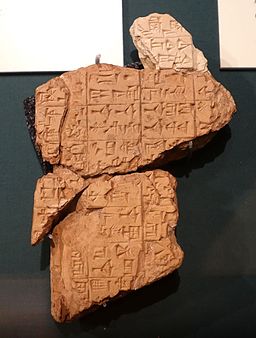
Fragments of the Instructions of Shuruppak: "Shurrupak gave instructions to his son: Do not purchase an ass which brays besides much. Do not commit rape upon a homo's daughter, exercise not announce it to the courtyard. Do non answer dorsum against your male parent, do non raise a 'heavy eye.'". From Adab, c. 2600–2500 BCE[6]
When writing systems were created in ancient civilizations, a variety of objects, such as stone, clay, tree bark, metallic sheets, and bones, were used for writing; these are studied in epigraphy.
Tablet
A tablet is a physically robust writing medium, suitable for casual transport and writing. Clay tablets were flattened and mostly dry pieces of clay that could be easily carried, and impressed with a stylus. They were used as a writing medium, particularly for writing in cuneiform, throughout the Bronze Age and well into the Iron Age. Wax tablets were pieces of woods covered in a coating of wax thick enough to record the impressions of a stylus. They were the normal writing fabric in schools, in accounting, and for taking notes. They had the advantage of being reusable: the wax could be melted, and reformed into a blank.
The custom of binding several wax tablets together (Roman pugillares) is a possible forerunner of modern bound (codex) books.[vii] The etymology of the give-and-take codex (block of wood) also suggests that it may take developed from wooden wax tablets.[8]
Whorl

Scrolls can exist fabricated from papyrus, a thick newspaper-similar textile made past weaving the stems of the papyrus plant, then pounding the woven sheet with a hammer-like tool until it is flattened. Papyrus was used for writing in Aboriginal Egypt, perhaps every bit early equally the Start Dynasty, although the first testify is from the business relationship books of King Neferirkare Kakai of the 5th Dynasty (most 2400 BC).[9] Papyrus sheets were glued together to form a scroll. Tree bawl such as lime and other materials were too used.[10]
According to Herodotus (History 5:58), the Phoenicians brought writing and papyrus to Hellenic republic around the 10th or 9th century BC. The Greek give-and-take for papyrus as writing material (biblion) and book (biblos) come from the Phoenician port town Byblos, through which papyrus was exported to Greece.[xi] From Greek nosotros also derive the give-and-take tome (Greek: τόμος), which originally meant a slice or slice and from in that location began to denote "a scroll of papyrus". Tomus was used by the Latins with exactly the same meaning as volumen (see also below the caption by Isidore of Seville).
Whether made from papyrus, parchment, or paper, scrolls were the dominant grade of book in the Hellenistic, Roman, Chinese, Hebrew, and Macedonian cultures. The more mod codex book format form took over the Roman world past late artifact, simply the whorl format persisted much longer in Asia.
Codex

A Chinese bamboo book meets the modernistic definition of Codex
Isidore of Seville (died 636) explained the so-current relation between codex, book and scroll in his Etymologiae (Half-dozen.xiii): "A codex is composed of many books; a volume is of one coil. It is chosen codex past way of metaphor from the trunks (codex) of trees or vines, as if information technology were a wooden stock, because it contains in itself a multitude of books, as it were of branches." Modern usage differs.
A codex (in modernistic usage) is the first information repository that mod people would recognize as a "book": leaves of uniform size jump in some way along ane edge, and typically held betwixt two covers fabricated of some more robust material. The showtime written mention of the codex every bit a course of book is from Martial, in his Apophoreta CLXXXIV at the end of the first century, where he praises its firmness. However, the codex never gained much popularity in the pagan Hellenistic world, and just within the Christian customs did information technology proceeds widespread use.[12] This change happened gradually during the third and 4th centuries, and the reasons for adopting the codex course of the book are several: the format is more economic, as both sides of the writing material tin be used; and it is portable, searchable, and piece of cake to conceal. A book is much easier to read, to find a page that you desire, and to flip through. A roll is more than awkward to utilise. The Christian authors may also take wanted to distinguish their writings from the infidel and Judaic texts written on scrolls. In addition, some metal books were made, that required smaller pages of metal, instead of an impossibly long, unbending scroll of metal. A volume can also exist easily stored in more compact places, or side by side in a tight library or shelf infinite.
Manuscripts

The fall of the Roman Empire in the fifth century AD saw the turn down of the civilisation of ancient Rome. Papyrus became difficult to obtain due to lack of contact with Egypt, and parchment, which had been used for centuries, became the main writing material. Parchment is a material made from processed beast skin and used—mainly in the past—for writing on. Parchment is most commonly made of calfskin, sheepskin, or goatskin. It was historically used for writing documents, notes, or the pages of a book. Parchment is limed, scraped and dried under tension. It is not tanned, and is thus different from leather. This makes it more suitable for writing on, but leaves it very reactive to changes in relative humidity and makes it revert to rawhide if overly wet.
Monasteries carried on the Latin writing tradition in the Western Roman Empire. Cassiodorus, in the monastery of Vivarium (established effectually 540), stressed the importance of copying texts.[13] St. Benedict of Nursia, in his Rule of Saint Benedict (completed around the heart of the sixth century) later also promoted reading.[fourteen] The Rule of Saint Benedict (Ch. XLVIII), which fix aside certain times for reading, greatly influenced the monastic civilization of the Middle Ages and is one of the reasons why the clergy were the predominant readers of books. The tradition and style of the Roman Empire withal dominated, but slowly the peculiar medieval volume culture emerged.
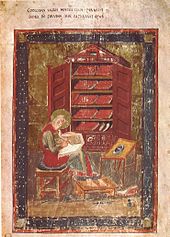
The Codex Amiatinus anachronistically depicts the Biblical Ezra with the kind of books used in the eighth Century AD.
Before the invention and adoption of the press press, nigh all books were copied by hand, which fabricated books expensive and comparatively rare. Smaller monasteries unremarkably had but a few dozen books, medium-sized perhaps a few hundred. By the 9th century, larger collections held around 500 volumes and even at the end of the Middle Ages, the papal library in Avignon and Paris library of the Sorbonne held but effectually ii,000 volumes.[15]
The scriptorium of the monastery was unremarkably located over the affiliate firm. Artificial light was forbidden for fear information technology may harm the manuscripts. There were five types of scribes:
- Calligraphers, who dealt in fine book production
- Copyists, who dealt with basic production and correspondence
- Correctors, who collated and compared a finished book with the manuscript from which it had been produced
- Illuminators, who painted illustrations
- Rubricators, who painted in the ruby letters

Burgundian writer and scribe Jean Miélot, from his Miracles de Notre Dame, 15th century.
The bookmaking process was long and laborious. The parchment had to be prepared, and then the unbound pages were planned and ruled with a blunt tool or pb, after which the text was written past the scribe, who normally left blank areas for illustration and rubrication. Finally, the book was jump by the bookbinder.[16]

Dissimilar types of ink were known in antiquity, commonly prepared from soot and gum, and later also from gall basics and iron vitriol. This gave writing a brownish black color, but blackness or brown were not the only colors used. There are texts written in red or even gold, and different colors were used for illumination. For very luxurious manuscripts the whole parchment was colored imperial, and the text was written on information technology with gold or silver (for example, Codex Argenteus).[17]
Irish monks introduced spacing betwixt words in the 7th century. This facilitated reading, as these monks tended to be less familiar with Latin. However, the use of spaces between words did not become commonplace before the twelfth century. It has been argued that the use of spacing between words shows the transition from semi-vocalized reading into silent reading.[18]
The starting time books used parchment or vellum (calfskin) for the pages. The book covers were made of wood and covered with leather. Because dried parchment tends to assume the form it had earlier processing, the books were fitted with clasps or straps. During the later Middle Ages, when public libraries appeared, up to the 18th century, books were often chained to a bookshelf or a desk to prevent theft. These chained books are called libri catenati.
At first, books were copied mostly in monasteries, one at a time. With the rise of universities in the 13th century, the Manuscript culture of the time led to an increase in the need for books, and a new system for copying books appeared. The books were divided into unbound leaves (pecia), which were lent out to different copyists, and then the speed of book production was considerably increased. The system was maintained past secular stationers guilds, which produced both religious and non-religious material.[19]
Judaism has kept the art of the scribe live upwardly to the present. Co-ordinate to Jewish tradition, the Torah whorl placed in a synagogue must be written by hand on parchment and a printed book would not do, though the congregation may utilize printed prayer books and printed copies of the Scriptures are used for report outside the synagogue. A sofer "scribe" is a highly respected member of any observant Jewish community.
Middle E
People of various religious (Jews, Christians, Zoroastrians, Muslims) and ethnic backgrounds (Syriac, Coptic, Persian, Arab etc.) in the Middle Due east likewise produced and spring books in the Islamic Gilt Age (mid eighth century to 1258), developing advanced techniques in Islamic calligraphy, miniatures and bookbinding. A number of cities in the medieval Islamic world had book production centers and volume markets. Yaqubi (died 897) says that in his time Baghdad had over a hundred booksellers.[20] Book shops were often situated around the town'southward principal mosque[21] equally in Marrakesh, Morocco, that has a street named Kutubiyyin or volume sellers in English language and the famous Koutoubia Mosque is named so because of its location in this street.
The medieval Muslim world likewise used a method of reproducing reliable copies of a volume in large quantities known every bit bank check reading, in dissimilarity to the traditional method of a single scribe producing simply a single copy of a single manuscript. In the check reading method, merely "authors could authorize copies, and this was washed in public sessions in which the copyist read the copy aloud in the presence of the writer, who and so certified it as accurate."[22] With this check-reading arrangement, "an author might produce a dozen or more than copies from a single reading," and with two or more readings, "more than than one hundred copies of a single book could easily be produced."[23] By using equally writing material the relatively inexpensive paper instead of parchment or papyrus the Muslims, in the words of Pedersen "accomplished a feat of crucial significance not but to the history of the Islamic book, only as well to the whole world of books".[24]
Wood block printing

In woodblock printing, a relief image of an entire page was carved into blocks of wood, inked, and used to print copies of that page. This method originated in China, in the Han dynasty (earlier 220 AD), as a method of printing on textiles and later paper, and was widely used throughout Due east Asia. The oldest dated book printed by this method is The Diamond Sutra (868 AD). The method (chosen woodcut when used in fine art) arrived in Europe in the early 14th century. Books (known as block-books), as well equally playing-cards and religious pictures, began to exist produced by this method. Creating an entire book was a painstaking process, requiring a hand-carved block for each page; and the wood blocks tended to crevice, if stored for long. The monks or people who wrote them were paid highly.
Movable type and incunabula

A 15th-century Incunable. Discover the blind-tooled cover, corner bosses and clasps.

Selected Teachings of Buddhist Sages and Son Masters, the primeval known book printed with movable metal type, printed in Korea, in 1377, Bibliothèque nationale de France.
The Chinese inventor Bi Sheng made movable type of earthenware c. 1045, simply there are no known surviving examples of his printing. Around 1450, in what is commonly regarded as an independent invention, Johannes Gutenberg invented movable type in Europe, along with innovations in casting the blazon based on a matrix and hand mould. This invention gradually made books less expensive to produce, and more widely available.
Early printed books, single sheets and images which were created before 1501 in Europe are known as incunables or incunabula. "A man born in 1453, the year of the fall of Constantinople, could await back from his fiftieth year on a lifetime in which about eight million books had been printed, more mayhap than all the scribes of Europe had produced since Constantine founded his city in AD 330."[25]
19th century to 21st centuries
Steam-powered printing presses became pop in the early 19th century. These machines could print 1,100 sheets per 60 minutes,[26] but workers could merely set 2,000 letters per hour.[ citation needed ] Monotype and linotype typesetting machines were introduced in the late 19th century. They could gear up more 6,000 letters per hour and an entire line of type at in one case. There have been numerous improvements in the printing press. Every bit well, the conditions for freedom of the printing have been improved through the gradual relaxation of restrictive censorship laws. Encounter likewise intellectual property, public domain, copyright. In mid-20th century, European book product had risen to over 200,000 titles per year.
Throughout the 20th century, libraries take faced an e'er-increasing rate of publishing, sometimes chosen an information explosion. The advent of electronic publishing and the internet means that much new information is not printed in paper books, but is made available online through a digital library, on CD-ROM, in the course of ebooks or other online media. An on-line book is an ebook that is available online through the internet. Though many books are produced digitally, most digital versions are not available to the public, and there is no decline in the rate of paper publishing.[27] There is an effort, however, to convert books that are in the public domain into a digital medium for unlimited redistribution and infinite availability. This attempt is spearheaded by Project Gutenberg combined with Distributed Proofreaders. In that location have also been new developments in the process of publishing books. Technologies such as POD or "print on demand", which make it possible to print as few equally one book at a fourth dimension, have made self-publishing (and vanity publishing) much easier and more than affordable. On-demand publishing has immune publishers, past avoiding the high costs of warehousing, to keep low-selling books in print rather than declaring them out of impress.
Indian manuscripts
Goddess Saraswati epitome dated 132 AD excavated from Kankali tila depicts her property a manuscript in her left hand represented as a bound and tied palm leaf or birch bark manuscript. In India a bounded manuscript made of birch bark or palm leaf existed next since artifact.[28] The text in palm leaf manuscripts was inscribed with a pocketknife pen on rectangular cut and cured palm leafage sheets; colourings were then applied to the surface and wiped off, leaving the ink in the incised grooves. Each canvass typically had a hole through which a string could laissez passer, and with these the sheets were tied together with a string to bind like a volume.
Mesoamerican Codex
The codices of pre-Columbian Mesoamerica (Mexico and Central America) had the same form as the European codex, but were instead made with long folded strips of either fig bark (amatl) or plant fibers, often with a layer of whitewash applied before writing. New World codices were written as late every bit the 16th century (come across Maya codices and Aztec codices). Those written before the Spanish conquests seem all to have been single long sheets folded concertina-manner, sometimes written on both sides of the local amatl newspaper.
Modernistic manufacturing
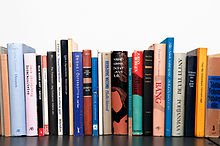
The spine of the book is an of import aspect in book design, especially in the comprehend blueprint. When the books are stacked upward or stored in a shelf, the details on the spine is the only visible surface that contains the information about the book. In stores, it is the details on the spine that concenter a heir-apparent's attending first.
The methods used for the printing and binding of books continued fundamentally unchanged from the 15th century into the early 20th century. While there was more than mechanization, a book printer in 1900 had much in common with Gutenberg. Gutenberg's invention was the utilize of movable metallic types, assembled into words, lines, and pages then printed by letterpress to create multiple copies. Modern paper books are printed on papers designed specifically for printed books. Traditionally, volume papers are fair or low-white papers (easier to read), are opaque to minimise the show-through of text from one side of the page to the other and are (normally) made to tighter caliper or thickness specifications, particularly for example-bound books. Different newspaper qualities are used depending on the type of book: Machine finished coated papers, woodfree uncoated papers, coated fine papers and special fine papers are common paper grades.
Today, the majority of books are printed past offset lithography.[29] When a volume is printed, the pages are laid out on the plate then that later on the printed sail is folded the pages will be in the correct sequence. Books tend to be manufactured nowadays in a few standard sizes. The sizes of books are usually specified as "trim size": the size of the folio after the sheet has been folded and trimmed. The standard sizes outcome from sheet sizes (therefore machine sizes) which became pop 200 or 300 years ago, and have come up to dominate the industry. British conventions in this regard prevail throughout the English-speaking world, except for the USA. The European book manufacturing industry works to a completely different set of standards.
Processes
Layout
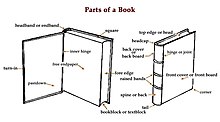
Parts of a modern case bound book
Modern bound books are organized according to a particular format called the volume'south layout. Although in that location is great variation in layout, modern books tend to attach to a set of rules with regard to what the parts of the layout are and what their content commonly includes. A basic layout will include a front cover, a dorsum cover and the book'southward content which is called its trunk copy or content pages. The front encompass often bears the book's title (and subtitle, if any) and the name of its author or editor(s). The within front cover folio is usually left bare in both hardcover and paperback books. The next section, if present, is the book'south front matter, which includes all textual material after the forepart cover but non part of the book'south content such as a foreword, a dedication, a table of contents and publisher data such as the book's edition or printing number and place of publication. Between the torso copy and the back cover goes the end matter which would include whatever indices, sets of tables, diagrams, glossaries or lists of cited works (though an edited volume with several authors usually places cited works at the end of each authored chapter). The inside dorsum cover page, similar that inside the forepart cover, is unremarkably bare. The back embrace is the usual identify for the volume's ISBN and maybe a photo of the author(s)/ editor(s), possibly with a short introduction to them. Also here often announced plot summaries, barcodes and excerpted reviews of the book.[30]
Printing

Some books, particularly those with shorter runs (i.e. with fewer copies) will be printed on canvas-fed commencement presses, but well-nigh books are now printed on web presses, which are fed by a continuous roll of paper, and can consequently impress more copies in a shorter time. As the product line circulates, a consummate "book" is collected together in i stack of pages, and some other machine carries out the folding, pleating, and stitching of the pages into bundles of signatures (sections of pages) ready to go into the gathering line. Note that the pages of a book are printed 2 at a time, not as ane complete book. Excess numbers are printed to brand up for whatever spoilage due to make-readies or exam pages to clinch terminal print quality.
A make-ready is the preparatory work carried out past the pressmen to get the printing press upward to the required quality of impression. Included in make-ready is the time taken to mount the plate onto the machine, make clean upwardly any mess from the previous job, and get the press up to speed. As presently equally the pressman decides that the printing is correct, all the make-ready sheets will be discarded, and the printing will offset making books. Like brand readies take identify in the folding and binding areas, each involving spoilage of paper.
Bounden
After the signatures are folded and gathered, they move into the bindery. In the heart of last century there were however many trade binders – stand-lone binding companies which did no printing, specializing in binding alone. At that fourth dimension, considering of the dominance of letterpress printing, typesetting and printing took place in one location, and binding in a dissimilar factory. When type was all metallic, a typical volume's worth of type would be bulky, frail and heavy. The less it was moved in this condition the improve: so printing would be carried out in the aforementioned location every bit the typesetting. Printed sheets on the other paw could easily be moved. Now, considering of increasing computerization of preparing a book for the printer, the typesetting part of the job has flowed upstream, where it is done either by separately contracting companies working for the publisher, by the publishers themselves, or fifty-fifty by the authors. Mergers in the volume manufacturing industry mean that information technology is now unusual to find a bindery which is not likewise involved in book printing (and vice versa).
If the book is a hardback its path through the bindery volition involve more points of action than if it is a paperback. Unsewn bounden, is now increasingly mutual. The signatures of a volume tin also exist held together by "Smyth sewing" using needles, "McCain sewing", using drilled holes often used in schoolbook binding, or "notch binding", where gashes nigh an inch long are made at intervals through the fold in the spine of each signature. The residual of the bounden process is similar in all instances. Sewn and notch jump books tin be bound as either hardbacks or paperbacks.
Finishing

"Making cases" happens off-line and prior to the book's arrival at the bounden line. In the most basic example-making, two pieces of cardboard are placed onto a glued piece of cloth with a infinite between them into which is glued a thinner board cut to the width of the spine of the book. The overlapping edges of the cloth (about 5/8" all round) are folded over the boards, and pressed down to attach. Later instance-making the stack of cases will go to the foil stamping surface area for calculation decorations and blazon.
Digital printing
Recent developments in book manufacturing include the development of digital printing. Book pages are printed, in much the same way as an function copier works, using toner rather than ink. Each book is printed in one pass, not every bit split up signatures. Digital printing has permitted the manufacture of much smaller quantities than offset, in part considering of the absence of brand readies and of spoilage. One might think of a spider web press as printing quantities over 2000, quantities from 250 to 2000 being printed on sail-fed presses, and digital presses doing quantities beneath 250. These numbers are of course only approximate and will vary from supplier to supplier, and from book to book depending on its characteristics. Digital printing has opened upwardly the possibility of print-on-demand, where no books are printed until after an order is received from a customer.
Ebook
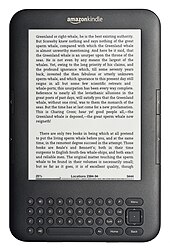
A screen of a Kindle east-reader.
In the 2000s, due to the rising in availability of affordable handheld computing devices, the opportunity to share texts through electronic means became an appealing option for media publishers.[31] Thus, the "ebook" was made. The term ebook is a wrinkle of "electronic book"; it refers to a volume-length publication in digital form.[32] An ebook is usually made available through the internet, but also on CD-ROM and other forms. Ebooks may be read either via a computing device with an LED display such as a traditional computer, a smartphone or a tablet computer; or by ways of a portable e-ink display device known as an ebook reader, such as the Sony Reader, Barnes & Noble Nook, Kobo eReader, or the Amazon Kindle. Ebook readers effort to mimic the experience of reading a print volume past using this technology, since the displays on ebook readers are much less cogitating.
Pattern
Book blueprint is the fine art of incorporating the content, style, format, blueprint, and sequence of the diverse components of a book into a coherent whole. In the words of Jan Tschichold, book design "though largely forgotten today, methods and rules upon which it is impossible to better have been developed over centuries. To produce perfect books these rules have to be brought back to life and applied." Richard Hendel describes volume design as "an cabalistic subject" and refers to the need for a context to understand what that means. Many dissimilar creators tin can contribute to book design, including graphic designers, artists and editors.
Sizes

Bodily-size facsimile of the Codex Gigas, also known equally the 'Devil's Bible' (from the illustration at right)

A page from the world'south largest book. Each page is iii and a one-half feet wide, 5 feet tall and a little over five inches thick
The size of a modern book is based on the printing surface area of a mutual flatbed printing. The pages of type were arranged and clamped in a frame, and so that when printed on a canvass of newspaper the full size of the press, the pages would be right side up and in order when the canvass was folded, and the folded edges trimmed.
The almost common volume sizes are:
- Quarto (4to): the sheet of newspaper is folded twice, forming 4 leaves (viii pages) approximately 11–xiii inches (c. 30 cm) tall
- Octavo (8vo): the virtually common size for electric current hardcover books. The sheet is folded three times into eight leaves (sixteen pages) up to 9+ 3⁄4 inches (c. 23 cm) tall.
- DuoDecimo (12mo): a size between 8vo and 16mo, up to vii+ 3⁄4 inches (c. xviii cm) tall
- Sextodecimo (16mo): the sheet is folded four times, forming xvi leaves (32 pages) upward to half-dozen+ 3⁄4 inches (c. 15 cm) tall
Sizes smaller than 16mo are:
- 24mo: upwards to five+ 3⁄4 inches (c. 13 cm) tall.
- 32mo: up to 5 inches (c. 12 cm) alpine.
- 48mo: up to 4 inches (c. 10 cm) tall.
- 64mo: up to 3 inches (c. 8 cm) tall.
Small books can be called booklets.
Sizes larger than quarto are:
- Folio: up to 15 inches (c. 38 cm) tall.
- Elephant Page: up to 23 inches (c. 58 cm) alpine.
- Atlas Folio: up to 25 inches (c. 63 cm) tall.
- Double Elephant Folio: upwardly to 50 inches (c. 127 cm) tall.
The largest extant medieval manuscript in the world is Codex Gigas 92 × 50 × 22 cm. The world's largest book is fabricated of stone and is in Kuthodaw Pagoda (Burma).
Types
By content
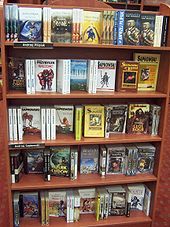
A mutual separation by content are fiction and non-fiction books. This unproblematic separation can be found in most collections, libraries, and bookstores. At that place are other types such as books of sheet music.
Fiction
Many of the books published today are "fiction", pregnant that they incorporate invented cloth, and are creative literature. Other literary forms such equally poetry are included in the broad category. Near fiction is additionally categorized by literary form and genre.
The novel is the most common class of fiction book. Novels are stories that typically feature a plot, setting, themes and characters. Stories and narrative are not restricted to any topic; a novel tin exist whimsical, serious or controversial. The novel has had a tremendous bear upon on entertainment and publishing markets.[33] A novella is a term sometimes used for fiction prose typically betwixt 17,500 and xl,000 words, and a novelette betwixt 7,500 and 17,500. A short story may be whatever length upward to ten,000 words, but these word lengths vary.
Comic books or graphic novels are books in which the story is illustrated. The characters and narrators apply speech or thought bubbles to limited exact language.
Non-fiction
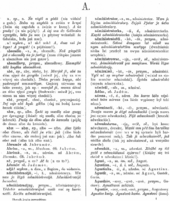
Non-fiction books are in principle based on fact, on subjects such as history, politics, social and cultural bug, besides as autobiographies and memoirs. Near all bookish literature is not-fiction. A reference book is a general type of non-fiction book which provides information as opposed to telling a story, essay, commentary, or otherwise supporting a betoken of view.
An annual is a very general reference book, usually one-volume, with lists of data and information on many topics. An encyclopedia is a book or set up of books designed to have more in-depth articles on many topics. A book listing words, their etymology, meanings, and other information is called a dictionary. A book which is a collection of maps is an atlas. A more specific reference book with tables or lists of data and information about a certain topic, often intended for professional use, is ofttimes called a handbook. Books which endeavor to list references and abstracts in a certain wide expanse may exist called an index, such as Engineering Index, or abstracts such equally chemical abstracts and biological abstracts.

Books with technical information on how to do something or how to use some equipment are chosen instruction manuals. Other popular how-to books include cookbooks and home improvement books.
Students typically store and carry textbooks and schoolbooks for written report purposes.
Unpublished
Many types of book are private, often filled in by the possessor, for a variety of personal records. Elementary school pupils oft use workbooks, which are published with spaces or blanks to exist filled by them for written report or homework. In Us higher educational activity, information technology is common for a student to take an test using a bluish volume.

There is a big set of books that are made only to write private ideas, notes, and accounts. These books are rarely published and are typically destroyed or remain private. Notebooks are blank papers to be written in by the user. Students and writers commonly use them for taking notes. Scientists and other researchers apply lab notebooks to tape their notes. They oftentimes feature spiral coil bindings at the border so that pages may hands exist torn out.
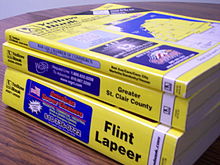
Address books, phone books, and agenda/appointment books are unremarkably used on a daily footing for recording appointments, meetings and personal contact information. Books for recording periodic entries by the user, such as daily information virtually a journeying, are called logbooks or simply logs. A similar volume for writing the owner'south daily private personal events, information, and ideas is chosen a diary or personal journal. Businesses use accounting books such every bit journals and ledgers to record financial data in a practise called bookkeeping (now usually held on computers rather than in manus-written class).
Other
In that location are several other types of books which are not ordinarily found under this system. Albums are books for belongings a group of items belonging to a particular theme, such as a set of photographs, card collections, and memorabilia. One mutual example is stamp albums, which are used by many hobbyists to protect and organize their collections of stamp stamps. Such albums are often made using removable plastic pages held within in a ringed binder or other similar holder. Picture show books are books for children with pictures on every folio and less text (or fifty-fifty no text).
Hymnals are books with collections of musical hymns that can typically be establish in churches. Prayerbooks or missals are books that contain written prayers and are commonly carried past monks, nuns, and other devoted followers or clergy. Lap books are a learning tool created by students.
Decodable readers and leveling
A leveled book collection is a prepare of books organized in levels of difficulty from the easy books appropriate for an emergent reader to longer more complex books adequate for advanced readers. Decodable readers or books are a specialized type of leveled books that use decodable text only including controlled lists of words, sentences and stories consistent with the letters and phonics that take been taught to the emergent reader. New sounds and messages are added to college level decodable books, as the level of instruction progresses, allowing for college levels of accuracy, comprehension and fluency.
By physical format
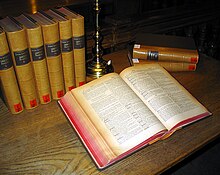

Hardcover books have a stiff binding. Paperback books have cheaper, flexible covers which tend to be less durable. An culling to paperback is the glossy embrace, otherwise known as a dust cover, establish on magazines, and comic books. Spiral-bound books are bound by spirals made of metallic or plastic. Examples of spiral-jump books include teachers' manuals and puzzle books (crosswords, sudoku).
Publishing is a process for producing pre-printed books, magazines, and newspapers for the reader/user to purchase.
Publishers may produce low-price, pre-publication copies known as galleys or 'bound proofs' for promotional purposes, such as generating reviews in accelerate of publication. Galleys are ordinarily made as cheaply as possible, since they are not intended for sale.
Dummy books

Cigarette smuggling with a book
Dummy books (or imitation books) are books that are designed to imitate a real book by advent to deceive people, some books may be whole with empty pages, others may be hollow or in other cases, in that location may be a whole panel carved with spines which are so painted to look like books, titles of some books may too exist fictitious.
There are many reasons to have dummy books on display such equally; to allude visitors of the vast wealth of information in their possession and to inflate the possessor's appearance of wealth, to conceal something,[34] for shop displays or for decorative purposes.
In early on 19th century at Gwrych Castle, North Wales, Lloyd Hesketh Bamford-Hesketh was known for his vast drove of books at his library, however, at the later office of that same century, the public became enlightened that parts of his library was a fabrication, dummy books were congenital and then locked behind glass doors to stop people from trying to access them, from this a proverb was built-in, "Like Hesky's library, all outside".[35] [36]
Libraries
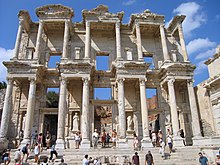
Private or personal libraries fabricated up of not-fiction and fiction books, (as opposed to the state or institutional records kept in archives) get-go appeared in classical Hellenic republic. In the ancient world, the maintaining of a library was usually (simply not exclusively) the privilege of a wealthy individual. These libraries could have been either individual or public, i.east. for people who were interested in using them. The deviation from a modernistic public library lies in that they were usually not funded from public sources. It is estimated that in the city of Rome at the stop of the tertiary century there were around 30 public libraries. Public libraries as well existed in other cities of the ancient Mediterranean region (for example, Library of Alexandria).[37] Later, in the Eye Ages, monasteries and universities had also libraries that could be attainable to general public. Typically not the whole collection was available to public, the books could not be borrowed and often were chained to reading stands to forestall theft.
The beginning of modern public library begins around 15th century when individuals started to donate books to towns.[38] The growth of a public library system in the United States started in the late 19th century and was much helped by donations from Andrew Carnegie. This reflected classes in a guild: The poor or the middle form had to access about books through a public library or past other means while the rich could afford to have a private library built in their homes. In the Us the Boston Public Library 1852 Report of the Trustees established the justification for the public library as a tax-supported establishment intended to extend educational opportunity and provide for general culture.[39]
The advent of paperback books in the 20th century led to an explosion of popular publishing. Paperback books fabricated owning books affordable for many people. Paperback books ofttimes included works from genres that had previously been published mostly in pulp magazines. As a effect of the low price of such books and the spread of bookstores filled with them (in improver to the creation of a smaller market place of extremely cheap used paperbacks) owning a private library ceased to be a status symbol for the rich.
In library and booksellers' catalogues, information technology is mutual to include an abbreviation such as "Crown 8vo" to bespeak the paper size from which the book is made.
When rows of books are lined on a book holder, bookends are sometimes needed to keep them from slanting.
Identification and classification

During the 20th century, librarians were concerned about keeping runway of the many books beingness added yearly to the Gutenberg Galaxy. Through a global society called the International Federation of Library Associations and Institutions (IFLA), they devised a series of tools including the International Standard Bibliographic Description (ISBD). Each book is specified past an International Standard Book Number, or ISBN, which is unique to every edition of every book produced by participating publishers, worldwide. It is managed by the ISBN Society. An ISBN has iv parts: the first role is the land code, the 2nd the publisher code, and the third the title code. The last part is a check digit, and tin have values from 0–nine and X (10). The EAN Barcodes numbers for books are derived from the ISBN past prefixing 978, for Bookland, and calculating a new check digit.
Commercial publishers in industrialized countries generally assign ISBNs to their books, so buyers may presume that the ISBN is office of a total international system, with no exceptions. However, many government publishers, in industrial every bit well as developing countries, do non participate fully in the ISBN arrangement, and publish books which practise non take ISBNs. A large or public collection requires a catalogue. Codes called "telephone call numbers" relate the books to the catalogue, and determine their locations on the shelves. Call numbers are based on a Library nomenclature arrangement. The phone call number is placed on the spine of the volume, commonly a short distance before the bottom, and inside. Institutional or national standards, such as ANSI/NISO Z39.41 – 1997, found the correct way to identify data (such as the title, or the proper noun of the author) on volume spines, and on "shelvable" book-like objects, such as containers for DVDs, video tapes and software.

Books on library shelves and telephone call numbers visible on the spines
One of the earliest and most widely known systems of cataloguing books is the Dewey Decimal Organization. Another widely known organization is the Library of Congress Nomenclature organisation. Both systems are biased towards subjects which were well represented in US libraries when they were developed, and hence have problems treatment new subjects, such as computing, or subjects relating to other cultures.[twoscore] Information about books and authors can be stored in databases like online general-interest book databases. Metadata, which means "information near data" is information about a book. Metadata nigh a book may include its title, ISBN or other nomenclature number (see above), the names of contributors (author, editor, illustrator) and publisher, its date and size, the language of the text, its subject thing, etc.
Classification systems
- Bliss bibliographic classification (BC)
- Chinese Library Nomenclature (CLC)
- Colon Classification
- Dewey Decimal Nomenclature (DDC)
- Harvard-Yenching Classification
- Library of Congress Classification (LCC)
- New Classification Scheme for Chinese Libraries
- Universal Decimal Nomenclature (UDC)
Uses
Aside from the primary purpose of reading them, books are too used for other ends:
- A volume can exist an artistic artifact, a slice of art; this is sometimes known every bit an artists' volume.
- A book may be evaluated by a reader or professional writer to create a book review.
- A volume may be read by a group of people to utilise equally a spark for social or bookish discussion, as in a book society.
- A book may exist studied by students as the subject of a writing and assay do in the grade of a book report.
- Books are sometimes used for their exterior appearance to decorate a room, such every bit a written report.
Marketing
Once the book is published, information technology is put on the market by the distributors and the bookstores. Meanwhile, his promotion comes from various media reports. Book marketing is governed by the law in many states.
Secondary spread
In recent years, the book had a 2d life in the form of reading aloud. This is chosen public readings of published works, with the assistance of professional readers (often known actors) and in shut collaboration with writers, publishers, booksellers, librarians, leaders of the literary world and artists.
Many individual or collective practices exist to increase the number of readers of a book. Among them:
- abandonment of books in public places, coupled or non with the use of the Internet, known as the bookcrossing;
- provision of free books in tertiary places like bars or cafes;
- itinerant or temporary libraries;
- free public libraries in the area.
Manufacture evolution
This grade of the book chain has hardly changed since the eighteenth century, and has not e'er been this way. Thus, the author has asserted gradually with fourth dimension, and the copyright dates only from the nineteenth century. For many centuries, especially before the invention of press, each freely copied out books that passed through his hands, adding if necessary his ain comments. Similarly, bookseller and publisher jobs have emerged with the invention of printing, which made the book an industrial product, requiring structures of production and marketing.
The invention of the Cyberspace, east-readers, tablets, and projects like Wikipedia and Gutenberg, are likely to change the book industry for years to come.
Paper and conservation

Paper was outset made in China equally early on as 200 BC, and reached Europe through Muslim territories. At starting time made of rags, the industrial revolution inverse paper-making practices, allowing for paper to exist made out of wood lurid. Papermaking in Europe began in the 11th century, although vellum was also common there equally page material up until the offset of the 16th century, vellum being the more expensive and durable option. Printers or publishers would ofttimes issue the same publication on both materials, to cater to more than i marketplace.
Paper made from woods lurid became popular in the early 20th century, because it was cheaper than linen or abaca cloth-based papers. Pulp-based paper fabricated books less expensive to the general public. This paved the way for huge leaps in the rate of literacy in industrialised nations, and enabled the spread of data during the Second Industrial Revolution.
Lurid paper, however, contains acrid which somewhen destroys the paper from within. Earlier techniques for making paper used limestone rollers, which neutralized the acid in the pulp. Books printed betwixt 1850 and 1950 are primarily at adventure; more recent books are ofttimes printed on acrid-costless or element of group i paper. Libraries today accept to consider mass deacidification of their older collections in order to prevent decay.
Stability of the climate is critical to the long-term preservation of newspaper and book fabric.[41] Adept air circulation is of import to keep fluctuation in climate stable. The HVAC system should be up to date and functioning efficiently. Light is detrimental to collections. Therefore, care should be given to the collections by implementing light command. Full general housekeeping issues tin be addressed, including pest control. In addition to these helpful solutions, a library must also make an attempt to be prepared if a disaster occurs, one that they cannot command. Fourth dimension and effort should be given to create a concise and constructive disaster programme to annul any damage incurred through "acts of God", therefore an emergency management plan should exist in place.
Run into also
- Outline of books
- Alphabet book
- Artist's book
- Audiobook
- Bibliodiversity
- Volume burning
- Booksellers
- Lists of books
- Miniature book
- Open access book
- Order for the History of Authorship, Reading and Publishing (Abrupt)
Citations
- ^ IEILS, p. 41
- ^ "Books of the earth, stand up and exist counted! All 129,864,880 of you lot". August 5, 2010. Retrieved Baronial 15, 2010.
After we exclude serials, we can finally count all the books in the earth. In that location are 129,864,880 of them. At to the lowest degree until Lord's day.
- ^ Curtis, George (2011). The Law of Cybercrimes and Their Investigations. p. 161.
- ^ "Book". Dictionary.com . Retrieved Nov 6, 2010.
- ^ "Northvegr – Holy Language Lexicon". November iii, 2008. Archived from the original on Nov iii, 2008. Retrieved December 30, 2016.
- ^ Biggs, Robert D. (1974). Inscriptions from Tell Abū Ṣalābīkh (PDF). Oriental Institute Publications. Academy of Chicago Press. ISBN0-226-62202-9.
- ^ Leila Avrin. Scribes, Script and Books, p. 173.
- ^ Bischoff, Bernhard (1990). Latin palaeography antiquity and the Middle Ages. Dáibhí ó Cróinin. Cambridge: Cambridge University Press. p. 11. ISBN978-0-521-36473-7.
- ^ Avrin, Leila (1991). Scribes, script, and books: the book arts from artifact to the Renaissance. New York, New York: American Library Association; The British Library. p. 83. ISBN978-0-8389-0522-7.
- ^ Dard Hunter. Papermaking: History and Technique of an Ancient Arts and crafts New ed. Dover Publications 1978, p. 12.
- ^ Leila Avrin. Scribes, Script and Books, pp. 144–45.
- ^ The Cambridge History of Early on Christian Literature. Edd. Frances Immature, Lewis Ayres, Andrew Louth, Ron White. Cambridge University Press 2004, pp. 8–9.
- ^ Leila Avrin. Scribes, Script and Books, pp. 207–08.
- ^ Theodore Maynard. Saint Benedict and His Monks. Staples Press Ltd 1956, pp. seventy–71.
- ^ Martin D. Joachim. Historical Aspects of Cataloguing and Nomenclature. Haworth Printing 2003, p. 452.
- ^ Edith Diehl. Bookbinding: Its Background and Technique. Dover Publications 1980, pp. 14–16.
- ^ Bernhard Bischoff. Latin Palaeography, pp. xvi–17.
- ^ Paul Saenger. Space Between Words: The Origins of Silent Reading. Stanford University Press 1997.
- ^ Bernhard Bischoff. Latin Palaeography, pp. 42–43.
- ^ W. Durant, "The Historic period of Organized religion", New York 1950, p. 236
- ^ S.E. Al-Djazairi "The Golden Age of Islamic Civilization", Manchester 2996, p. 200
- ^ Edmund Burke (June 2009). "Islam at the Center: Technological Complexes and the Roots of Modernity". Periodical of Globe History. 20 (2): 165–86 [43]. doi:x.1353/jwh.0.0045. S2CID 143484233.
- ^ Edmund Burke (June 2009). "Islam at the Center: Technological Complexes and the Roots of Modernity". Journal of Earth History. twenty (ii): 165–86 [44]. doi:ten.1353/jwh.0.0045. S2CID 143484233.
- ^ Johs. Pedersen, "The Arabic Volume", Princeton University Printing, 1984, p. 59
- ^ Clapham, Michael, "Press" in A History of Applied science, Vol 2. From the Renaissance to the Industrial Revolution, edd. Charles Singer et al. (Oxford 1957), p. 377. Cited from Elizabeth L. Eisenstein, The Printing Printing as an Agent of Alter (Cambridge University, 1980).
- ^ Bruckner, D. J. R. (November twenty, 1995). "How the Earlier Media Achieved Disquisitional Mass: Printing Printing;Yelling 'Stop the Presses!' Didn't Happen Overnight". The New York Times . Retrieved August 13, 2020.
- ^ Bowker Reports Traditional U.S. Book Product Apartment in 2009 Archived Jan 28, 2012, at the Wayback Machine
- ^ Kelting, Chiliad. Whitney (Baronial 2, 2001). Singing to the Jinas: Jain Laywomen, Mandal Singing, and the Negotiations of Jain Devotion. Oxford University Press. ISBN978-0-19-803211-3.
- ^ Vermeer, Leslie (Baronial 31, 2016). The Complete Canadian Book Editor. Brush Didactics. ISBN978-1-55059-677-nine.
- ^ Gary B. Shelly; Joy L. Starks (January 6, 2011). Microsoft Publisher 2010: Comprehensive. Cengage Learning. p. 559. ISBN978-1-133-17147-8.
- ^ Rainie, Lee; Zickuhr, Kathryn; Purcell, Kristen; Madden, Mary; Brenner, Joanna (April 4, 2012). "The rise of eastward-reading". Pew Internet Libraries . Retrieved February 2, 2017.
- ^ "What is an e-book". Archived from the original on July 22, 2012. Retrieved December xxx, 2016.
- ^ Edwin Mcdowell (Oct 30, 1989). "The Media Concern; Publishers Worry After Fiction Sales Weaken". The New York Times . Retrieved January 25, 2008.
- ^ Golder, Joseph (October 28, 2021). "Human Finds Hugger-mugger Passage Hidden Backside Bookshelf in His 500-Twelvemonth-Old Home's Library". Newsweek.com. Retrieved February 25, 2022.
- ^ Dictionary of Proverbs By George Latimer Apperson (2006) – page 279. https://books.google.co.uk/books?redir_esc=y&id=7PMZJqSR4sAC&q=hesk%27s#5=onepage
- ^ Notes and Queries, Volume s12-10, Event 206, Page 233 – 25 March 1922 '"Pseudo Titles for "dummy books"'
- ^ Miriam A. Drake, Encyclopedia of Library and Computer science (Marcel Dekker, 2003), "Public Libraries, History".
- ^ Miriam A. Drake, Encyclopedia of Library, "Public Libraries, History".
- ^ McCook, Kathleen de la Peña (2011), Introduction to Public Librarianship, 2nd ed., p. 23 New York, Neal-Schuman.
- ^ Hoffman, Gretchen Fifty. (August five, 2019). Organizing Library Collections: Theory and Practice. Rowman & Littlefield. p. 167. ISBN978-ane-5381-0852-nine.
- ^ Patkus, Beth (2003). "Assessing Preservation Needs, A Cocky-Survey Guide". Andover: Northeast Document Conservation Center.
General sources
- "Book", in International Encyclopedia of Data and Library Science ("IEILS"), Editors: John Feather, Paul Sturges, 2003, Routledge, ISBN 1-134-51321-6, 9781134513215
Further reading
- Tim Parks (August 2017), "The Books Nosotros Don't Empathise", The New York Review of Books
External links
- Information on Old Books, Smithsonian Libraries
- "Manuscripts, Books, and Maps: The Printing Press and a Changing World"
villarrealwholubt.blogspot.com
Source: https://en.wikipedia.org/wiki/Book
0 Response to "Sword Art Online Light Novel 11 English Download Mobi"
Post a Comment